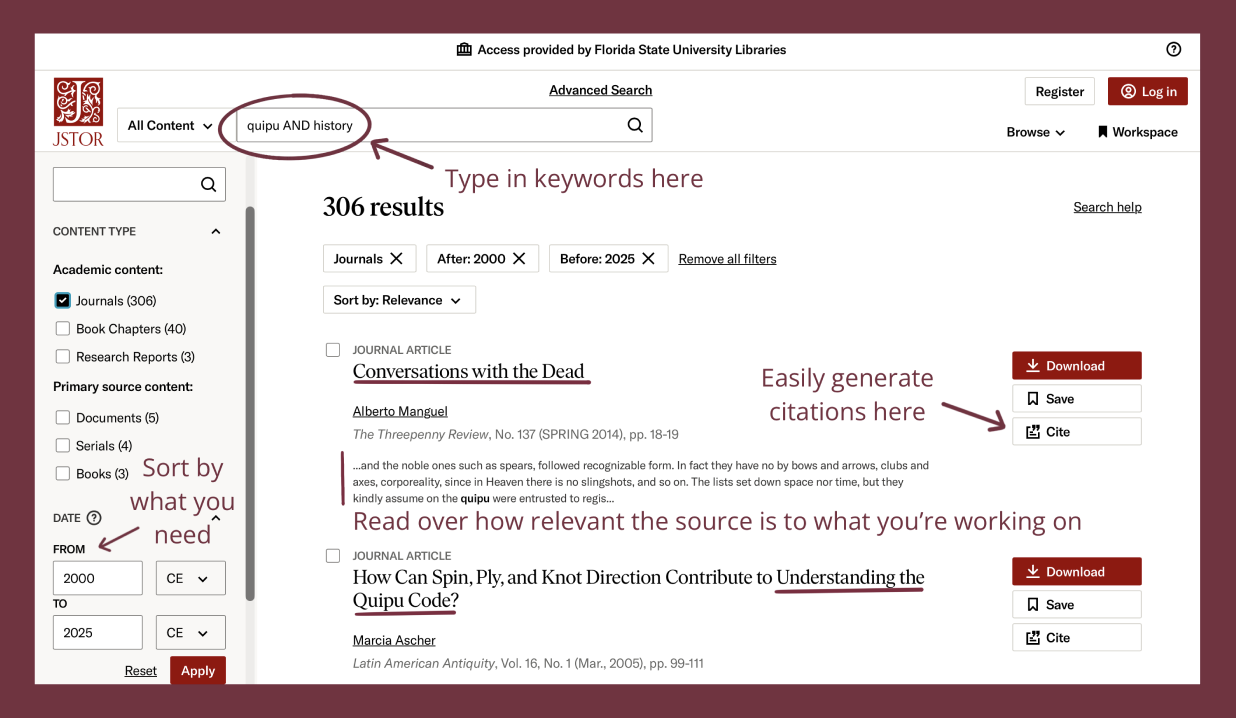
Searching for Sources
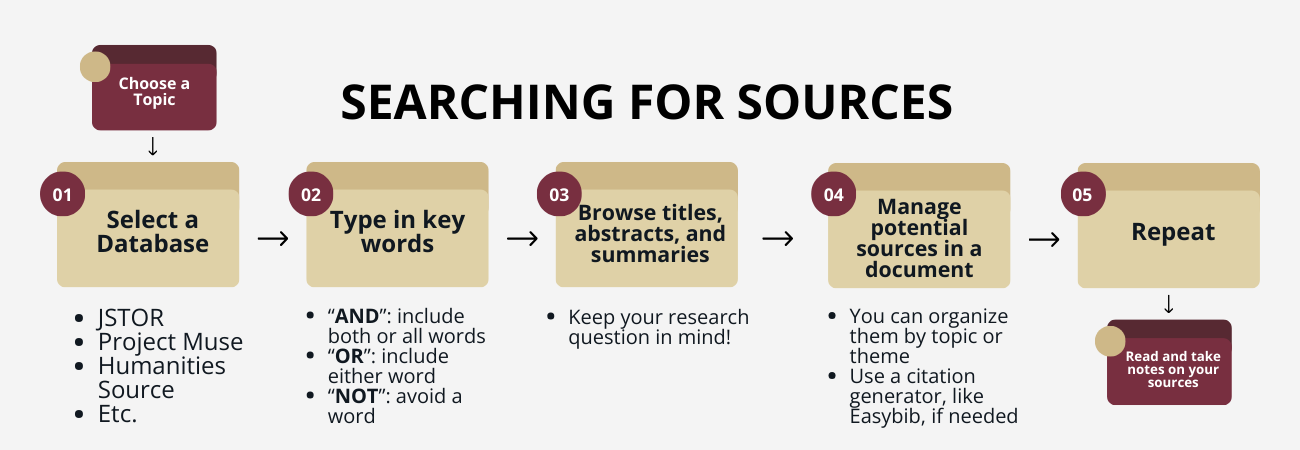
At this stage, you have hopefully constructed a thesis statement or research question(s) to base your research on. Finding the right sources is about purposeful selection and effective search logic.
Primary Sources
Original documents, raw evidence, and first-hand data.
- Interviews & Raw Data
- Novels & Artworks
- Government Documents
Secondary Sources
Analyses, reviews, or summaries of primary evidence.
- Literary Criticism
- Peer-Reviewed Articles
- Documentaries
Refining Your Search: Boolean Operators
Use these "Logic Tags" in FSU Library databases to control your results:
AND — Includes both words (Narrows search)
OR — Includes either word (Broadens search)
NOT — Avoids specific words (Excludes results)
Example: Quipu AND history | Quipu OR Inca | Quipu NOT Yupana
Primary Examples (Quipu)
- The Khipu Database
Direct photo examples of artifacts. - Crónicas del Perú
Spanish conquistador’s first-hand account.
Secondary Examples (Quipu)
- World History Encyclopedia
Historical overview and context. - JSTOR Analysis
Scholarly critique of quipu code.
Writing Tip Note your sources down immediately! Even if you aren't ready to cite them, keep a running document with links and titles. It is normal (and good!) to refine your research question as you discover new information.